 (This is my post #8 in the 14:14 Picture Book Element Blog Review Challenge, conducted by Christie Wild, February 14-28, 2014)
Title: Lightship
Author: Brian Floca
Illustrator: Brian Floca
Publisher: Athenum Books for Young Readers
Year: 2007
Words: 354
Fond of ships and the sea and sea stories, I was attracted to this book. I had heard of Brian Floca’s “Locomotive” picture book in a recent review that teased my interest. So I selected “Lightship” as a review practice for this challenge.
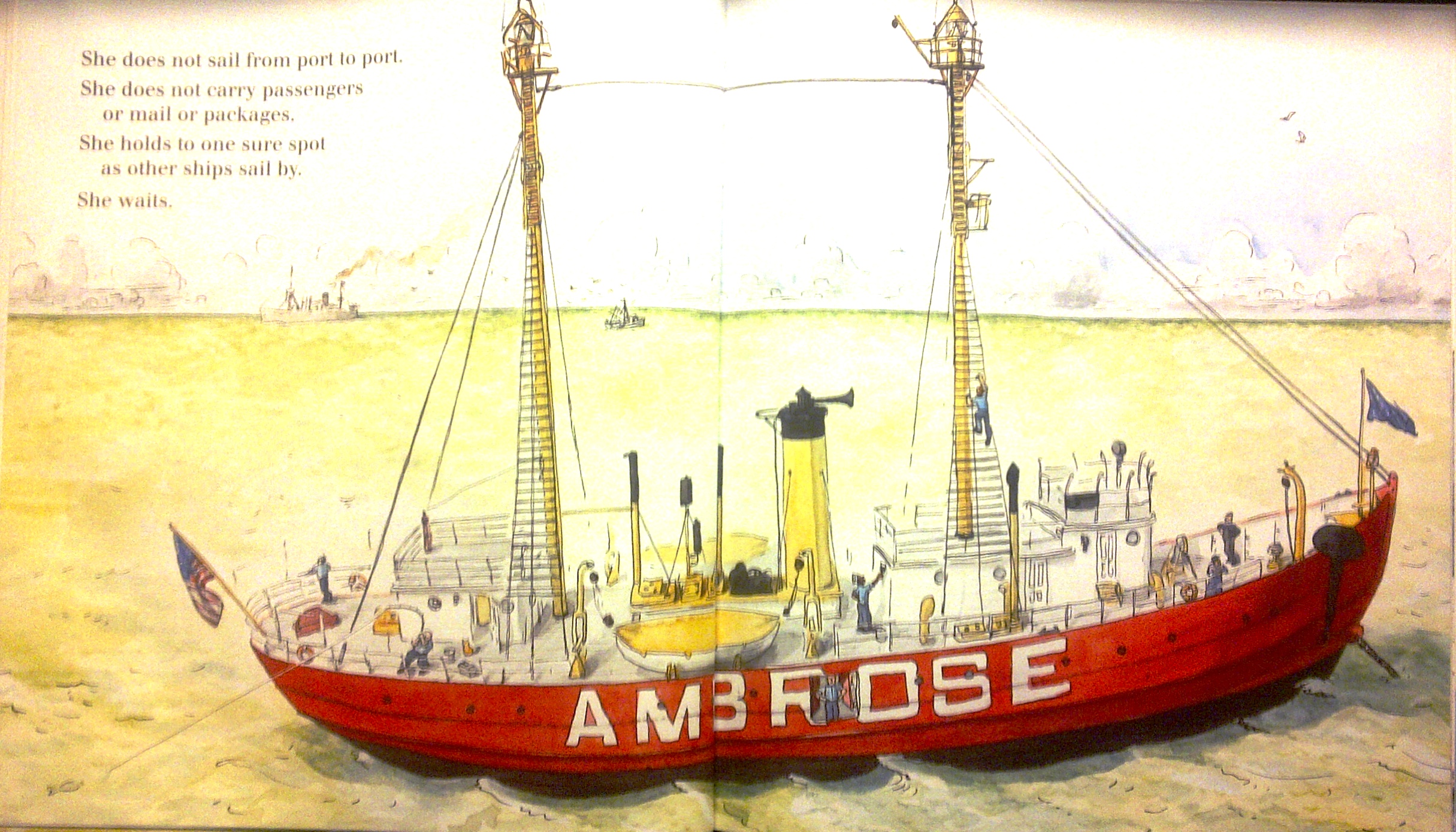
The ink and watercolor illustrations are rich with detail, and definitely provide at least half of the fact-fuel for this piece of non-fiction. Even the crew depictions, with their diverse roles, facial expressions, and looks (including the deckhand’s tattoos and the cook’s bald head) add reality to the story. Even the ship’s cat is introduced, who appears throughout the book as a faithful crew member.
What seems to be the substantial and core picture book element in this title is character. The way Floca introduces the lightship in the first sentence declares that the ship herself is the story:
“Here is a ship that holds her place”
On the next spread the author introduces the captain and crew. But to me it seems as if the ship is introducing her own children. Then the next spread returns to the vessel as the main character, using a lyrical description of her unusual duty:
“She does not sail from port to port.
She does not carry passengers
or mail or packages.
She holds to one sure spot
as other ships sail by.
She waits.”
The story then describes the crew’s life and duty on the ship. It almost sounds like a proud mother citing her children’s hard work and accomplishments, which are to:
“…keep her anchored in sun and calm…and snow and cold.
…keep her anchored when other ships come closer than they should.”
The crew does this and more, all to be certain the lightship “holds her one sure spot.”
Floca continues to alternate crew life with statements of the ship’s purpose. With this back-and forth banter between the ship’s role and the crew’s support, an aspect of character is exposed which is basic to most character-driven stories. That aspect is relationship.
While words and thoughts and expressions and reactions are used to define a player in a story, a character is best known and understood by the reflection of that person, animal, (or inanimate object in this case) to those secondary characters they interact with. Other characters are often why they speak and think and express themselves and react. That interaction between characters may involve support, association, inspiration, or conflict. But the relationships help to validate and define the character.
Floca has masterfully chosen to use relationship as an avenue to reveal the lightship’s dutiful, steady, faithful, and brave character.
Can an inanimate object have character traits? Why do we call a ship a ‘she?’ Why do we personalize institutions, like our country, or our churches? Why might someone fondly describe a favorite car as “my baby” or give names to favorite animals or things?
It is the relationships that people have with each other, usually involving things or places or associations, that often give those things character. This can be a powerful tool in non-fiction about inanimate things that I had not, myself, previously recognized.
Is your inanimate object, are your animals, characters whose traits and personalities are enhanced and validated by their relationships with others in your stories?
Perhaps you can share in your comments how you have used relationships to build up the strength of character as an element in your writing.
14:14 PB ELEMENT Blog Review: CHARACTER & CONFLICT – Looking at Wangari’s Trees of Peace by Jeanette Winter
 (Post #7 of the 14:14 Picture Book Element Blog Review Challenge, conducted by Christie Wild, February 14-28, 2014)
Title: Wangari’s Trees of Peace
Author: Jeanette Winter
Illustrator: Jeanette Winter
Publisher: Harcourt , Inc.
Year: 2008
Words: 556
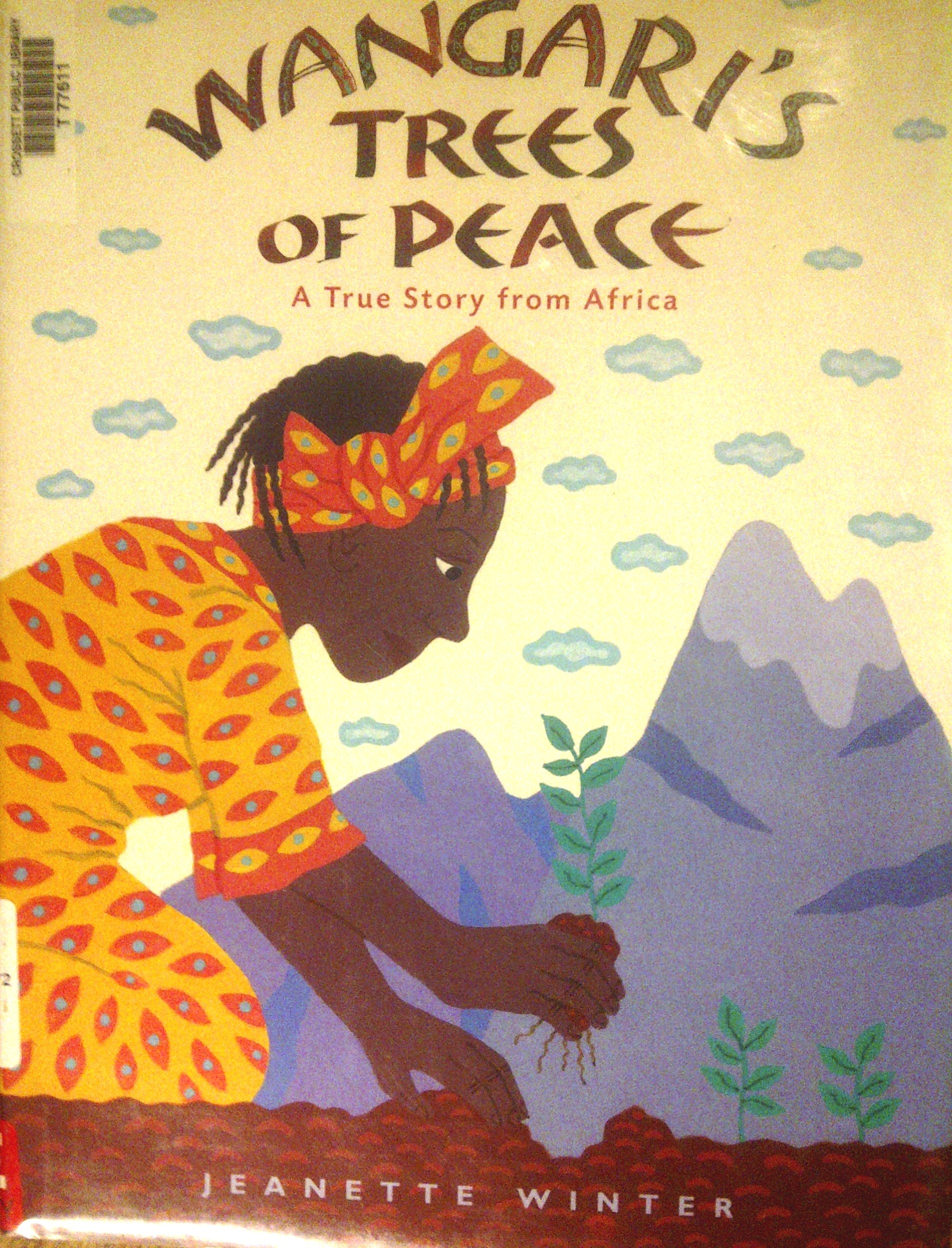
“The earth was naked. For me the mission was to try to cover it with green.” A quote from the title character, Wangari Maathai, serves as a forward to this delightful true story of a brave woman in Africa who was awarded the Nobel Peace Prize in 2004. Jeanette Winter uses several strong elements in this story. Wangari’s tale is related from childhood, and progresses to her adult life, and pivots at the point of conflict when she returns from America to find her homeland, Kenya, vastly changed.
That interplay of character and conflict form the crux for this story. Wangari’s childhood in the lush forests of her home is pictured in stark contrast to a barren land she returns to as an adult, after her education in America.
Story tense is important here. The present tense that’s used for the story presents the conflict as real and immediate to the character. This tends to lend the urgency of the problem to the reader, as well.
Point of view is important also. Her heartfelt responses are italicized. “Will all of Kenya become a desert? she wonders as her tears fall.” Wangari’s observations and worries are stated first hand.
At this point her thoughts prompt a reaction to the dilemma, and she starts a movement fueled by determination, courage, and patience. Her character demonstrates leadership as women all over Kenya help take up the cause, even when she faces the conflict by being beaten and imprisoned for protesting deforestation.
“But Wangari is not alone.
Talk of the trees spreads over all of Africa,
like ripples in Lake Victoria.”
Readers will feel and sense Wangari’s courage in the face of trials as she succeeds, with the following of other African women, in reforesting Africa. Often biographies don’t emphasize the importance of support from friends and allies in the work our heroes do, but this book shows that character has an effect outside oneself, and that is a beautiful aspect of the story of this brave woman.
I want my characters to be strong in my stories, and the only way to demonstrate that to the reader is to provide some conflict. I am prompted to examine them all to be sure I have written them that way.
How do your characters behave to show their strengths, their values, their talents? I hope you will share in any comments.
14:14 PB ELEMENT Blog Review: WORDPLAY – Looking at Stars Beneath Your Bed by April Pulley Sayre
 (This is post #6 of my 14:14 Picture Book Element Reviews, conducted by Christie Wild, February 14-28, 2014)
Title: Stars Beneath Your Bed
Author: April Pulley Sayre
Illustrator: Ann Jonas
Publisher: Greenwillow Books / HarperCollins Publishers
Year: 2005
Words: 987
I don’t remember if I read a review of this book, or whether it had caught my eye in the local library, but I was familiar with it. I decided to revisit it and analyze it for story elements as part of the 14:14 Picture Book Challenge.
The most striking element that immediately becomes obvious in this book is the use of wordplay. Sayre poses her story of dust in a way that is immediately pleasant and personal. Her skillful use of prose describing the presence and origin of dust involves several aspects of this element. The late Ann Jonas’ scenic illustrations strengthen the effect of wordplay in each colorful spread.
First and most obvious is her use of lyrical language. Her words flow like a dust cloud, gently and deliberately, throughout the story. Look at this first page section:
“At sunrise,
the sun, low in the sky,
peeks through dusty air.
Dust from us and dirt and dinosaurs
scatters light, painting the sky like fire.
You can hear the smooth flow if you read it aloud. And if you look closer, there are several aspects of wordplay that can be tagged. Look at it again, as I diagram the wordplay:
Sayre writes this pa ragraph with similar phonemes, the sounds of long ‘i’ and short ‘u’ repeated. The alliteration of “dusty, dust, dirt, and dinosaurs” and choosing verbs that have the sun “peek[ing]” and “painting” add to the lyrical flow of this passage.
With this diagram it’s obvious that Sayre has made use of alliteration and phonemes to ‘create’ that delicate sense of flow with her words. This continues throughout the story. Metaphor is employed as well, with the sun ‘painting the sky like fire.”
But juxtaposition is another aspect of wordplay employed here with the meanings of words.
Sayer throws onto the first page an idea that ‘wows’ me. “Dust from us and dirt and dinosaurs…”
I immediately am mixing it up with extinct creatures. That sparks an instant interest in my mind. She continues to mix the dust of dogs (robust animals) with the dust of butterflies (delicate insects). The idea that “burning toast” and “erupting volcanos” have something in common heightens my interest. And makes breakfast much more intriguing. This wordplay juxtaposition continues in the story, with oceans/deserts, with outer space/forests.
This is a delightful use of wordplay and I am made more conscious of the power of contrasting meaning and relevant opposites when I engage this element in my story writing.
How have you used the elements of wordplay in your writing? Hope you will share in your comments.
14:14 PB ELEMENT Blog Review: PATTERN – Looking at The Wolves are Back by Jean Craighead George
 (This is my #5 post of the 14:14 PB Element Challenge offered by Christie Wild, February 14-28, 2014)
Title: The Wolves Are Back
Author: Jean Craighead George
Illustrator: Wendell Minor
Publisher: Dutton Children’s Books
Year: 2008
Words: 785
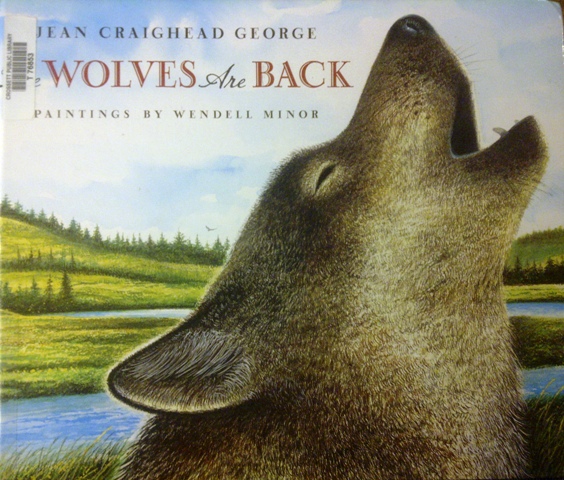
This book attracted my eye by the cover…a young wolf howling, full evidence in visual (and audible) form of the certainty of the title, “The Wolves Are Back.” Though I couldn’t actually hear the howl, I could see it, and much of the wonderful illustration by Wendell Minor does the same throughout the book to give the reader a visual avenue for hearing, touch, taste and smell.
The most striking story element I have noticed in this book is the use of pattern throughout the text. Author Jean George has ‘punctuated’ her passages of simple, imagery filled descriptions with two repeating phrases. These four-word phrases are like drum rolls that emphasize the meaning and theme of the book. Here’s an excerpt from page one where the pattern begins:
“The wolf pup pricked up his ears, pattered out of the den, and followed his father down the slope. They jogged through the lush grasses to the bank of the Lamar River in Yellowstone National Park. There they came upon the carcass of an elk their pack had felled.
The wolves were back!”
That title phrase provides the spine of the pattern throughout the book, but is given a strong emphasis by a related contrasting phrase that follows each ‘backstory’ passage. George describes times before the wolves returned, and modifies the phrase to relate the stark contrasts of an imbalanced environment.
“Where had they been?
Shot. Every one.
Many years ago…there were no wolves in the forty eight states. No voices howled. The thrilling chorus of the wilderness was silenced.
The wolves were gone.”
The contrasting phrase is repeated as the prior state of growing imbalance is described spread by spread. Eventually the story of the wolves return is told, and with each natural response to more balance in the ecosystem, the crescendo “The wolves were back” is repeated.
Hope returns with the wolves as the pup goes south to find a mate, dig a den, and continue to have their designed effect on the environment. The book concludes, of course, with:
“The wilderness is in balance again.
The wolves are back.”
Contrasting repetition is a simple pattern technique I haven’t noticed before, though I’m sure I’ve seen it used in other non-fiction picture books. Certainly it has been effective in fiction picture books. What comes to mind? Well, in P.D. Eastman’s Go, Dog, Go there’s the famous “Do you like my hat? No I do not!” The contrast (or conflict) in that example is within the repeated phrase.
I am prompted to examine my writing to see if patterns with contrast, either intact within repeated phrases, or as contrasting repeated phrases, could have a positive effect on how my themes are communicated to the reader.
What patterns with contrast have you used in your writing? What are some you have read? Share them here in your comments.
14:14 PB ELEMENT Blog Review: RHYME – Looking at I and You and Don’t Forget Who by Brian Cleary
 Title: I and You and Don’t Forget Who
Author: Brian P. Cleary
Illustrator: Brian Gable
Publisher: Carolrhoda Books Inc./Lerner Publishing Group
Year: 2004
Words: 383
I thought I would have to depart from reviewing only non-fiction books for the 14:14 Picture Book Element Review Challenge, but thankfully there was one set on the shelf published just within the time-frame. I and You and Don’t Forget Who is a part of a set of picture books by Brian P. Cleary, illustrated by Brian Gable, that teach parts of speech.
It feels odd to me to consider this a ‘non-fiction’ title because in general I think of non-fiction in terms of science, nature, and history. But it qualifies as non-fiction, even though it’s almost like a textbook that kids wouldn’t recognize as a textbook.
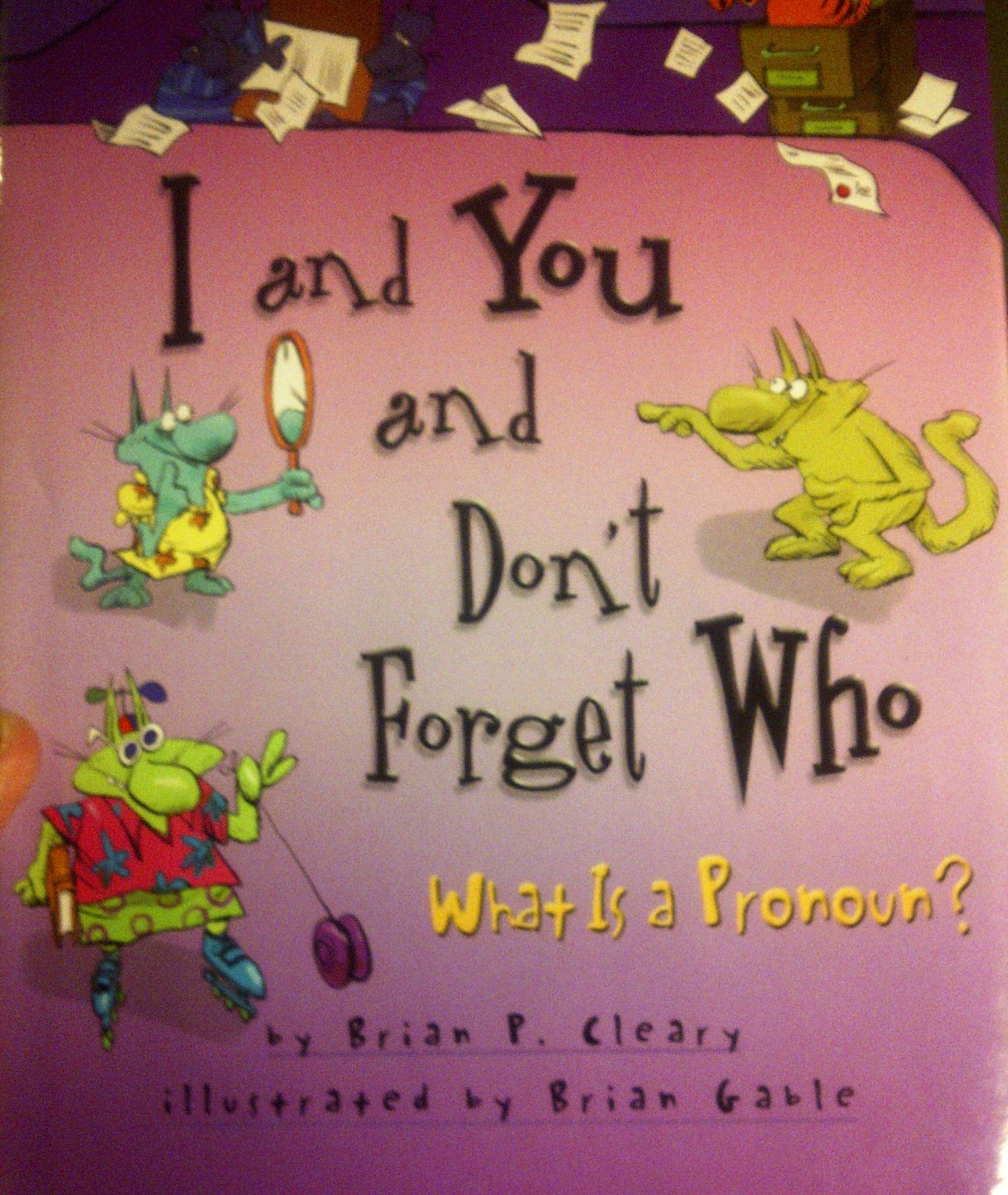
I have this title on pronouns, another on adverbs, and yet another on prepositions. The ‘pun-like’ motto in the upper right corner of each cover states that ‘Words Are CATegorical.” And sure enough, cats are the characters who, in scene to scene, and Brian Cleary has used them in clever text to demonstrate humorous situations in which various uses, meanings, and purposes of pronouns are made clear. Brian Gable’s whimsical multi-colored cats are comical, expressive, and fun. The collaboration on this book must have been fun.
What makes this a ‘sneaky textbook’ however is the use of a picture book story element you don’t often seen in instructive text: rhyme. The title betrays that as a rhyming title, and each spread, hosted by some of the silliest cats you’ll ever see, is full of rhyme describing pronouns.
The first spread starts out straightforwardly, with cats on stage, cats in a marching band, and a little bit of cat-in-the-mirror grooming going on:
“He is a pronoun. She is a pronoun. Even lil’ ol’ me is a pronoun.
“So is I. So is you, whom, and they and we and who.”
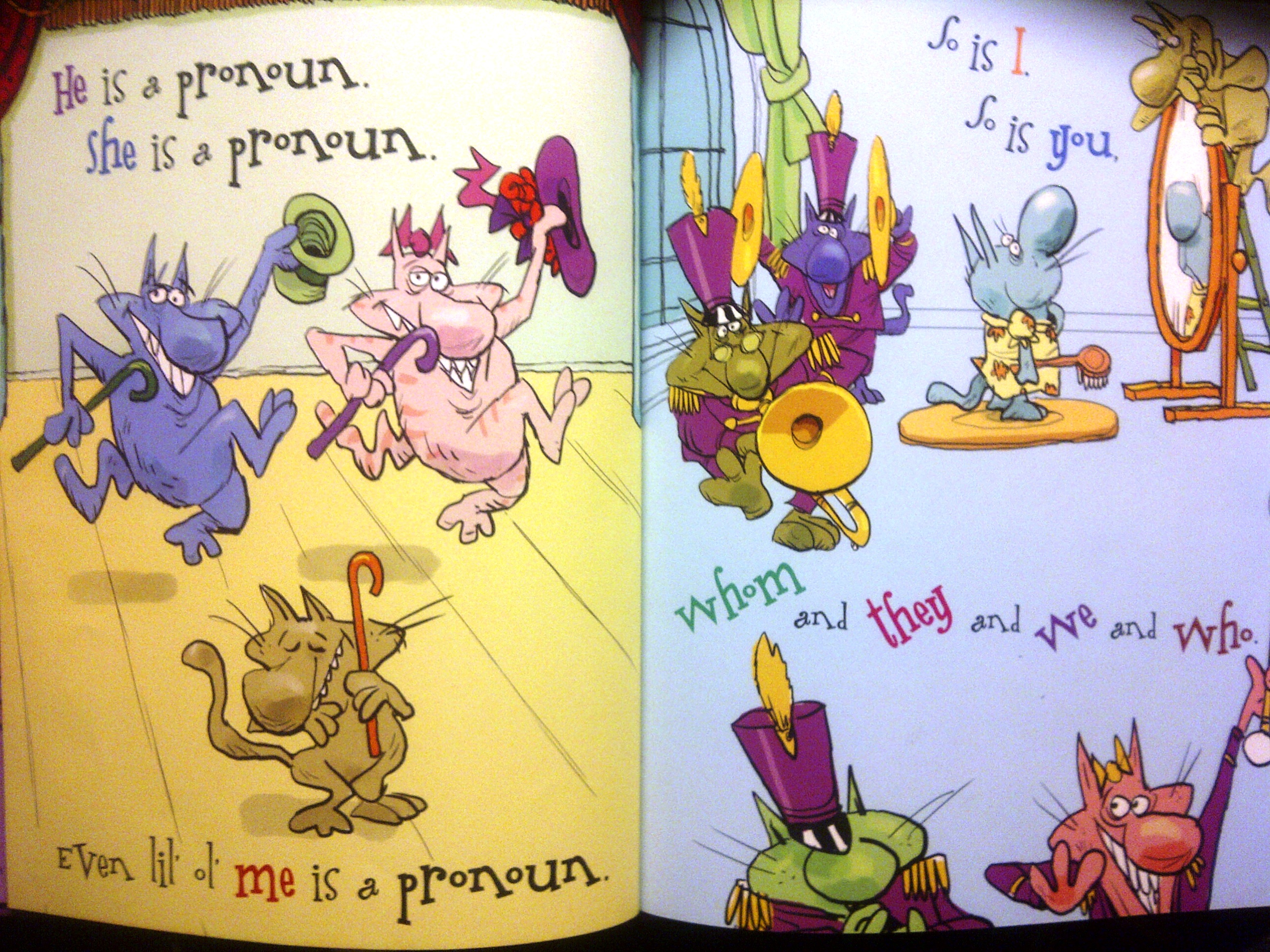 Each pronoun, of course, is printed in color. The text in this book is in a font that is whimsical, matching the comical cats. But the strength of the text is in the rhyme and meter, which to me seems well done. The rhythm isn’t sing-song, and varied enough from one spread to another so that meaning isn’t trumped by the rhyme element.
While the text is certainly simple, the conceptual aspect of the statements, definitions, and uses of pronouns limit this book to better readers, perhaps in third through fifth grades. A teacher at any level could read and explain each spread and the corresponding definitions to younger children, when they are ready to grasp the concepts of parts-of-speech. Why, because the rhyme adds interest to the concept.
The rhyme element lends the concepts to possible memorization by children, and as a retired educator I know the value of memorized rhymes and ditties and songs to learning—from language (“I before E except after C”) to math to history (“Columbus crossed the ocean blue in fourteen-hundred-and-ninety-two.”).
Which leads to the whole point about using rhyme in children’s books, especially picture books: is it useful? That’s a question I must ask myself, and if you’ve read very many of my posts, you probably know I lean toward poetic writing. I write adult and children’s poems, and many of my picture book ideas are sparked by a witty little two-line rhyme. So the question is particularly important for me.
Is rhyming for this story purposeful? Does it enhance the story? Does it detract from something more meaningful? Is character, or theme, plot, or the conflict compromised by rhyme?
Do you write in rhyme, and how does it affect your story?
Share if you dare. (Sorry…couldn’t resist on that one…)
14:14 PB ELEMENT Blog Review: BEGINNINGS AND ENDINGS – Looking at Desert Baths by Darcy Pattison
 (My post #3 in the 14:14 PB Blog Review challenge, offered by Christie Wild, February 14-28, 2014)
Title: Desert Baths
Author: Darcy Pattison
Illustrator: Kathleen Reitz
Publisher: Sylvan Dell Publishing
Year: 2012
Words: 492
Desert Baths, another non-fiction picture book by Darcy Pattison and illustrated by Kathleen Reitz, shows the exemplary use of story elements that make for a rich reading and listening experience. This is a great companion book to Pattison’s Prairie Storms, with the same descriptive approach for illustrative moments in the lives of animals, this time desert animals. While several story elements here are strong (such as word play), there is one element that I think really enhances the story.
While pacing (a related element) is definitely present in this book, the progression of bath times throughout a desert day give us a distinct sense of beginnings and endings. The way Pattison reveals each moment in the day through an animal’s experience depicts the day itself as the main character. Consider these time-of-day phrases as each of the twelve animals’ baths are described:
“The desert dawn sends light…”
“…early morning water…”
“…hoping for a late morning rain…”
“…hiding from the hot noon sun…”
“…doze in the early afternoon heat…”
“…late afternoon heat shimmers…”
“…sunset stains the western sky…”
“…under the glittering evening stars…”
“…night—time to forage…”
“…by midnight, he’s full…”
“…in the wee hours of the morning…”
“…in the pre-dawn light.”
The first aspect of beginnings and endings in this story is what I call closure. I find that the two opposite ends of the story connect. Morning of one day meets the morning of another. The reader knows that the cycle has been completed. That cycle validates the strength of this story, because nothing feels as good as story coming to completeness. It’s a kind of satisfaction that humans long for, the settled state that even nature seems to love.
But another aspect of beginnings and endings in this story is what I call continuation. The morning-to-morning cycle isn’t a closed ring. What follows is not the same day, but a new day, that may be similar and familiar, but might be different too. While we want and love satisfaction, we also relish curiosity and wonder. The cycle of morning-to-morning doesn’t create a closed repeating circle, it creates a forward repeating spiral. And that sense of a forward moving story is as satisfying as closure.
I am challenged: do my stories’ beginnings and endings offer both closure and continuation? Depending on the story, continuation might not be as critical as closure. Maybe closure isn’t as important as the idea that something else, something related, might happen in another story down the road. Perhaps both are important to you, the writer as well as the reader.
I have a story about a dog who meets a goat. She doesn’t like the goat at first, but after getting the goat’s help in a backyard emergency, the dog accepts the goat and his amazing ability. As the crisis is concluded (closure), the dog wonders how she might be able to learn the goat’s special skill (continuation).
I wouldn’t have been able to recognize the beginnings and endings aspects of that story before exploring this element in Desert Baths. Thanks to this exercise, I’m more sensitive to the role of this story element in my work. Maybe you can share in your comments–what role do beginnings and endings play in your writing?

(My post #2 of the 14:14 Picture Book Blog Review Challenge conducted by Christie Wild of Write Wild, February 14-28, 2014.)
Title: Pinduli
Author: Janell Cannon
Illustrator: Janell Cannon
Publisher: Scholastic, Inc.
Year: 2004
Words: 1308
I joined the 14:14 PB Challenge late…like Friday night at 10:30 pm (CST). Had a family reunion Saturday out of town. Library was closed when I got home. Tonight, scrambling for another non-fiction picture book from my shelves, I realized in a panic that all I had were pre-2004. Until I found Janell Cannon’s Pinduli.
While I am personally foggy on how strictly qualifiers should be applied for a picture book in order for it to be tagged non-fiction, I feel like this book qualifies. First, there’s a full four additional pages, after the story, of hyena facts, as well as the advantages of being bald and striped and big-eared. (Sounds like a book for old guys like me.) Secondly, the ‘fictional’ tale relies on ‘factual’ elements throughout, facts that are critical to the story line.
But Pinduli is a young hyena with a problem. He and Mom are hungry, as she tells him not to wander far in the early African morning. Then he meets insults from cape dogs, old lions, and zebras. His attempts to assuage his declining self-esteem in the wake of these insults sort of ‘modifies’ his appearance, and the white dust of the dry earth, clinging to damp fur, with his lowered ears transforms him into a ghostly figure.
The unintentional fear his appearance causes among his tormentors causes them to conclude he is the Great Spirit, there to punish them for their cruelty to a young hyena earlier that morning. They repent, and their pursuit for forgiveness causes a revival on the savannah and solves the another problem for Penduli and his mother.
A delightful tale from the author of Stellaluna (1993) and Verdi (1997), the story of Pinduli (2004) rests on a solid theme line throughout that still has impact for kids ten years later, here in 2014.
When the young hyena is teased first about his stripes and ears by hyenas. “The pack erupted into wheezing laughter and galumphed away, tongues lolling.” A lion then describes her coat a ‘prickly fringe.” Then zebras at the watering hole are critical of her stripes, advising her to “take some of that unpleasant haziness out of your patterns.”
After each insult, Pinduli’s desperation mounts, and the experience brought back feelings of occasional teasing I suffered when I was a child.
Penduli makes attempts to ‘correct’ her image by lowering her ears, dunking in the pool, covering herself with dust. But her quick wit kicks into gear when her ghastly appearance scares the animals that teased her. When all eyes are on her, she decides to play along with their assumption. Her wise replies, which aim at the heart of the bullying she encountered, start a change of understanding.
She tells the frightened animals, “The Spirits want to know why you would commit such a hideous, awful, atrocious crime.”
As the animals confess their cruelty, hints emerge that they suffered similar insults. Pinduli commands them to return to those who wronged them, and through the resulting animal encounters it becomes clear that bullying begets bullying. The whole idea of unkindness stems back to earlier hurts and insults that can only be dealt with by forgiveness.
I think that the extension of the theme into the lives of the secondary characters gives strength to the story, and validates the theme for the reader as well.
I am encouraged to wonder about my own stories, and whether my themes run deep enough and wide enough to gain validity with the reader. For example:
- Does “curiosity driven exploration and resulting discovery” occur for only the main character, or are other secondary characters affected?
- Is my theme focused, and does it run as a continuous line throughout the story, beginning to end?
- Is the theme relative to the reader, even though couched in facts about nature, a fantasy story, or a conventional circumstanc?
I will be more aware of the depth and width of theme in my writing from now on.
And as to the question about Pinduli—fiction or non-fiction? If you’ve had the privilege to read it, what do you think? On what shelf does a book like this belong? Let me know your thoughts in your comments.
 (The first of my reviews of picture book elements in the 14:14 PB Blog Challenge, taking place February 14-28, 2014, presented by Christie Wild)
Title: Prairie Storms
Author: Darcy Pattison
Illustrator: Kathleen Reitz
Publisher: Sylvan Dell Publishing
Year: 2011
Words: 419
I should say this book sparked my interest in non-fiction picture-books two years ago when I first met Darcy Pattison at my first SCBWI conference in Arkansas. I couldn’t have been motivated by better examples of great non-fiction for several reasons. Even as a non-fiction book, several story elements in this book provide good examples for an aspiring writer like me.
The animals as characters respond in natural ways to various storms they encounter. Despite their responses being based on instinct, we get picture snapshots of what are almost human feelings: curiosity, nervousness, confidence, courage, relief. Each storm presents a unique conflict to each animal.
But the first and most obvious story element, at least to me, is the pacing.
I love the way Darcy Pattison relates storm aspects in this geographic region by pacing them through each month of the year. January’s prairie blizzard prompts a prairie chicken to dig a winter roost in the snow bank. February’s prairie dog breaks into the soft light of a foggy field. In a March storm sandhill cranes descend to the marsh, wading nervously as a tornado streaks across the prairie background.
I wondered, when I first read Prairie Storms, how this mattered. What was it about this month-by-month pace that made the book unique? Did subtle steps through the seasons, easily to relate to by even younger children, give the content validity? Was it that calendar months (clearly labeled in each of Reitz’s luscious spreads) were a familiar and comfortable sequence?
When I first read it to Bethany, my five-year-old granddaughter, I was given a clue. Before we could turn from March (with its tornado) to April showers and groundhogs, she said, “Wait! Wait, Poppy…when is it March?” and her furrowed brow showed me that she’d really like to be able to anticipate when a tornado might occur. I assured her March was behind us, and the next March was far away.
I think that predictability is pre-requisite to good story pacing. Too many changes too quickly presented, and the reader/listener is overwhelmed or confused. Wait too long between story events, and interest drops. Anticipation requires that we suspect something ‘else’ to happen. We love contrast, but at the same time the links between one event and the next make up a story stream.
At first glance our characters are the animals. But by the end of the story, it’s obvious the main character from beginning to end is weather. He is one character, with many personalities. And weather’s changing moods throughout the year provide the pacing that makes this non-fiction book a delightful story.
There’s much to treasure about this book. Full-bleed illustrations show the range of storms from fury to gentleness. You can feel the chill in November’s scene as icicles coat a bare branch. The story text seems to describe each animal’s natural reactions in a personal way. The eagle ‘endures’ the November sleet by ‘clenching’ his perch.
But underlying all the richness of story and image is that wonderful pacing that Pattison has used so well. Check out this book and I think you’ll understand what I mean when I say that this element is crucial to non-fiction story in every way. I hope to incorporate it in my writing, because anticipation is a reader response that cannot be ignored.
A Match Made in Heaven…
There’s some love in my near future. My creativity has been lonely too long. 

Looking back from the end of this writing year, I’ve been able to identify a major longing in my writing pursuit–regularity. Of all the things I need most in my writing, it’s increased discipline, some kind of structure, some notion of daily, loving attention to what I’ve written in order to fulfill it.
Of course, there are reasons for the lack of attention to stories and tales that have come out of a very creative year (Mom’s cancer, a more intense work schedule at the part-time consulting, Becky’s back-cracking fall from the horse). But no excuses. You see, even MINUTES dedicated per day to the writing passion is still, regardless of quantity, discipline.
I’ve known this. I’ve lived long enough to learn this. It’s just that I need reminding. The 12×12 Challenge has been a continual reminder, but as a last-minute person, I’ve missed having a few complete drafts this year. Recently PiBoIdMo reminded me. Thirty picture-book ideas in thirty days. The writing community at large encourages a focus on the whole writing effort.
But now, a new opportunity appears. ReviMo. This challenge seems to aim right at the heart of my writing weakness, and I’m excited to be participating. Meg Miller is offering between January 12-18, 2014, this seven-day (very do-able) intensive (sharp-focused) personal dare to revise selected writing drafts that are in danger of melting away from memory or molding on the dingy bookshelves of my mind.
You know how they say in relationships opposites attract? Good couples complement one another? What’s that romantic saying that sums up your love for someone? Oh yeah…”You complete me.
Creativity needs a partner, and the best candidate, I think, is Discipline. I think that ReviMo can do a little match-making in my writing world.
30-Exact IDEAS, 30-Plus Potential PBs
I DID it!
Got my 30 ideas in the  month of November thanks to the challenge by Tara Lazar and the cheering of 30+ guest writers/illustrators as well as hundreds of fellow authors.
PiBoIdMo was again a boon to creativity in my writing life. I focused my ideas this year on early readers, with one character, but dozens of ideas may come from this character’s adventures, and other ideas, as in past years, will be generated.
But BETTER than the ideas I listed, are the multiple lessons I learned about creativity through this month from guest bloggers. Their advice and experience combined to make PiBoIdMo a course worthy of college credit, and the ideas are there forever to recall, to review, to incorporate into my writing journey.
Tara Lazar has equipped us again to sail into the wild blue yonder and write free into the future! Thanks Tara, and this wonderful writing community, for a rich month of inspiration.









 SevenAcreSky